The Curve strategy on Meteora: a fee-farming magnet.
When to run Curve on Meteora DLMM: two-sided vs one-sided, how it compares to Spot and Bid-Ask, and my 80/20 hybrid for extra fees.
The Curve strategy is the secret weapon for @MeteoraAG pools where the price is expected to stick around one central level. Instead of spreading your liquidity flat like a pancake, or focusing it all on the edges, you build a Gaussian-like distribution that's thickest right in the middle.
This is the anti-volatility play. It works by giving the deepest liquidity to traders who are trading at or near the current price. Since most of your capital is concentrated in those central bins, you collect maximum fees on every little swap that happens in that tight range.
The twist you need to know: this power comes with a critical choice.
- Two-sided Curve: your stable, reliable workhorse for stablecoins and tight chop. Low stress, consistent fees.
- One-sided Curve: a degen's sniper rifle. High-risk, high-reward. Instant, massive IL if you're wrong.
You need to know the difference before you commit a single $SOL.

One-sided vs two-sided Curve: risk vs reward
The key difference here isn't the shape of the curve, it's what assets you end up holding when the price moves.
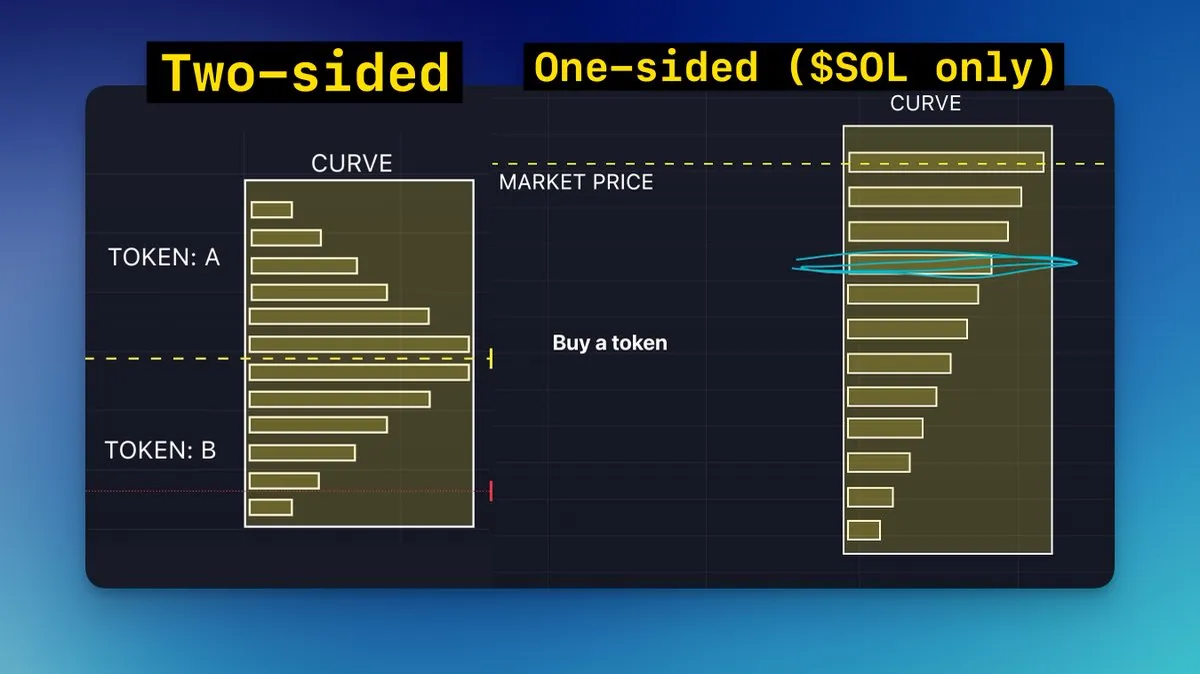
🟢 Two-sided Curve: the stable play. This is the standard, lower-risk setup for stable pairs (e.g. USDC/USDT, wSOL/SOL) or highly-correlated blue chips.
- Setup: you deposit both assets (e.g. USDC and USDT).
- Best use case: chop and range-bound markets, especially for stablecoins. Since stablecoins rarely break their peg, the price stays exactly in your concentrated middle, generating maximum fees with minimal impermanent loss (IL).
- Risk profile: low. Because the price is expected to stay in a small window, you have a high chance of staying in the concentrated bins to earn fees. You avoid significant IL because the assets are correlated or pegged.
🔴 One-sided Curve: the sniper risk. Using one-sided Curve (like $SOL-only) is extremely high-risk.
- Setup: you deposit only one asset (e.g. all $SOL). Most of your liquidity is concentrated at the current market price.
- The danger: if the price of the token drops fast, the big chunk of your liquidity quickly shifts down and converts your $SOL into the paired, falling token. Since the curve shape has most of the liquidity at the upper range, you convert capital very fast and expose yourself to massive, quick IL. However, you also generate high fees because most of your liquidity is tied up.
- Use case: I only use one-sided when I have extreme conviction the price will stay in a tight range, and I want to accumulate the paired token on tiny dips, not massive dumps. It is an advanced, aggressive strategy that requires constant monitoring. Avoid running it long-term, stick to quick in-and-out plays.
The bottom line: for reliable fee farming on Meteora, two-sided Curve on stable or heavily-ranging pairs is the way. One-sided Curve is a tactical play for degens who know exactly what they're doing and are ready to eat the IL if the trade goes south fast.
Curve vs Spot vs Bid-Ask: the real differences
The goal is always to farm fees, but how you set your liquidity dictates what market you win in. You need to stop using the same strategy for every market condition. Spot and Bid-Ask are great, but they are built for different missions than Curve.
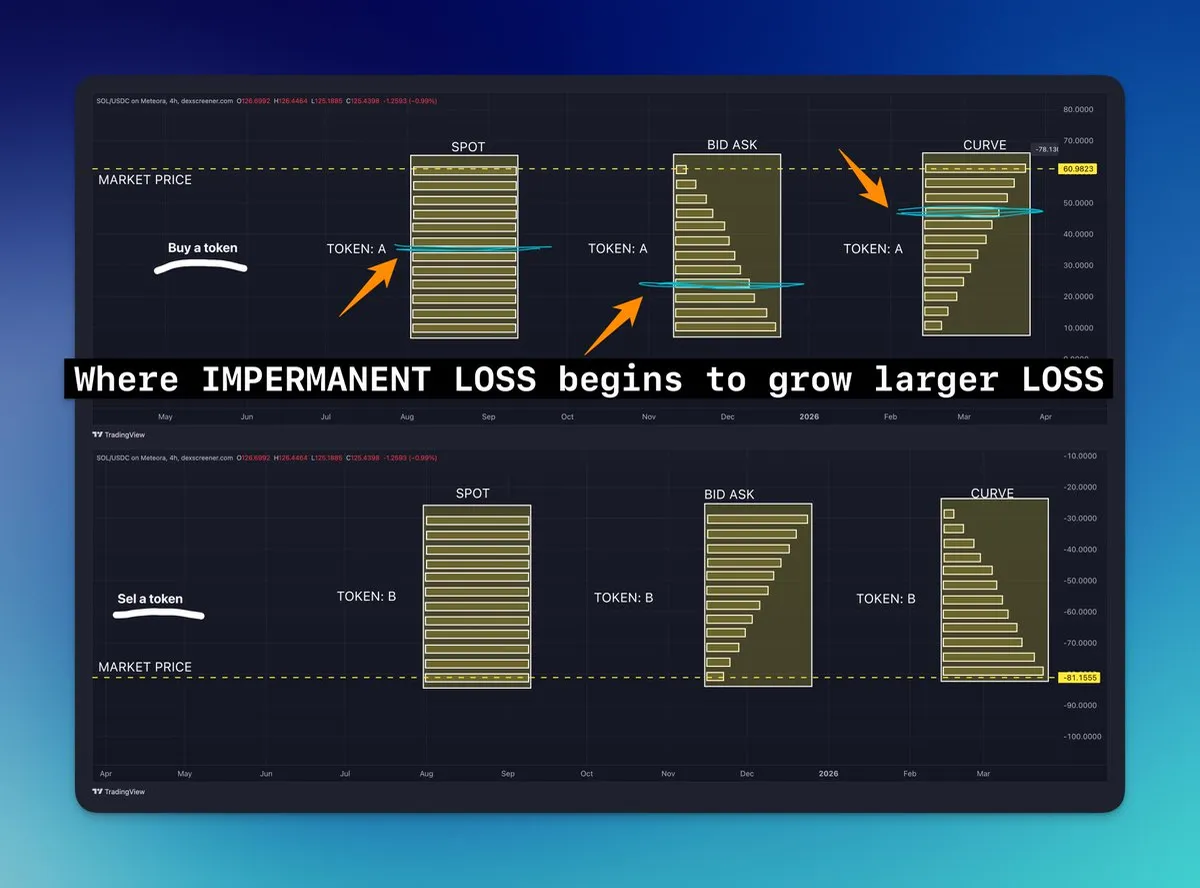
🟦 Spot. Your capital is spread evenly across all the bins in your range. Best for choppy, wider ranges where you have no strong directional conviction. It's a generalist approach, you earn consistent fees as the price moves up and down. The trade-off: because the liquidity is spread thin, you earn less fees on trades that happen right at the current price compared to Curve. You sacrifice depth for range coverage.
🟨 Bid-Ask. Liquidity is heavily concentrated at the outer edges of your price range. Best for directional plays: accumulate the paired token on dips (bid side) or sell it off on rallies (ask side). It's the strategy for a trending market or catching a bounce off a support level. The trade-off: when the price is stuck around your entry, you earn almost zero fees, because your capital is sitting uselessly below the price action.
🟢 Curve. Liquidity is heavily concentrated right at the current price, with a Gaussian, bell-curve shape. Best for stable pairs or tokens you expect to consolidate in a tight, predictable range. It maximizes fee capture on small, repetitive trades in the middle. The trade-off: if the price breaks out of the central focus area, you quickly lose fee-earning capability and expose yourself to the biggest IL relative to the other strategies.
Strategy 1: the $MON/SOL example
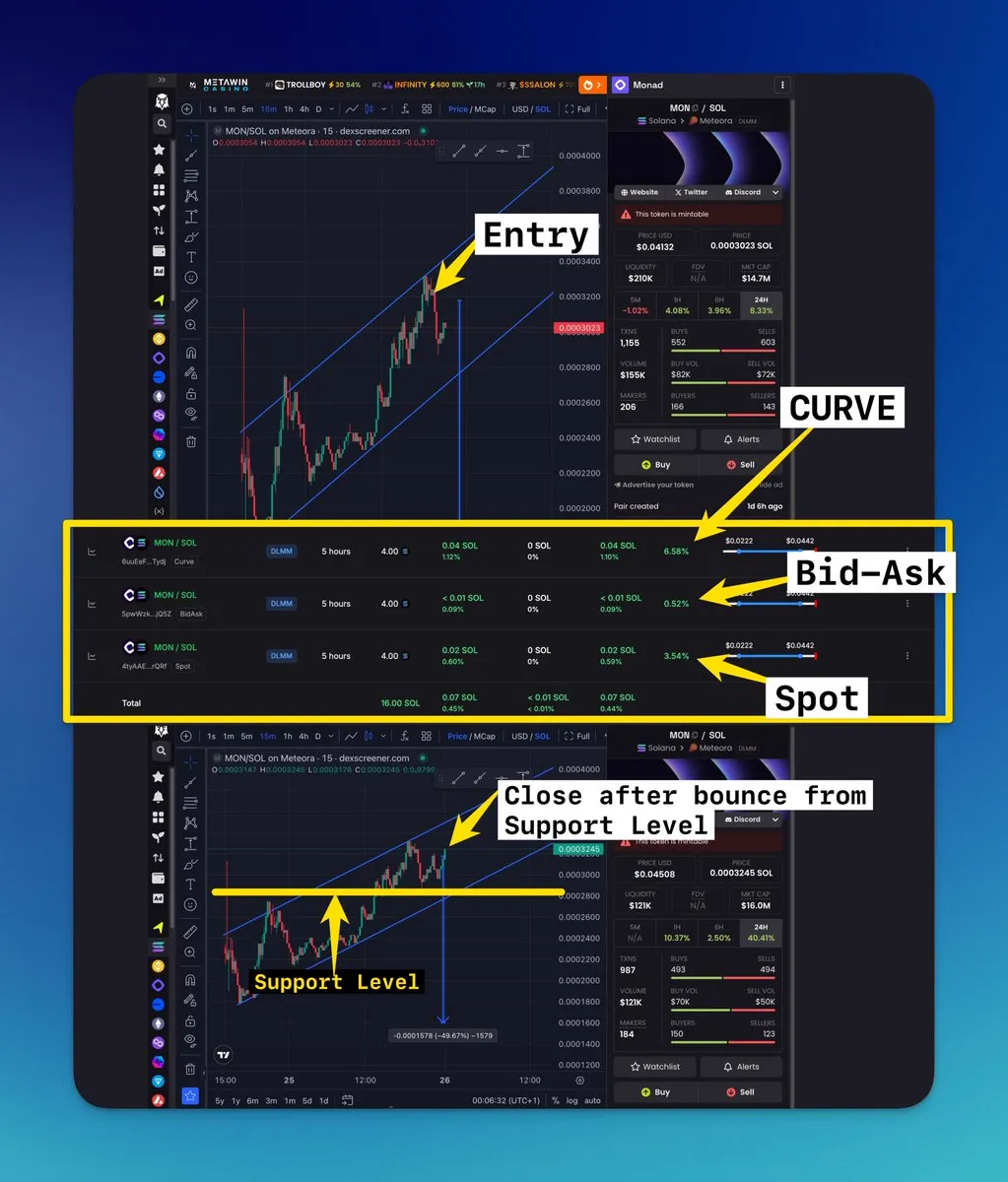
I set up three positions on the $MON/$SOL pair with the same range, same entry price, same amount of $SOL and bin count, running them simultaneously.
You can see the difference. In a range-bound or slightly bouncing market like $MON/SOL was here, where I expected a short-term bounce from the support level, Curve absolutely demolishes the competition in pure fee generation: Curve captured ~2x the fees of Spot. Bid-Ask was nearly dead.
Why? Because the price spent all its time exactly where Curve was concentrated (most of the liquidity). The small swings and trades happened over and over in that sweet spot, and Curve was perfectly positioned to vacuum every single fee.
The lesson: when you expect the price to stay around the entry price, or big bounces, you run Curve. However, when the price drops quickly, the impermanent loss increases, that's why timing is crucial here.
Strategy 2: the 80/20 hybrid, my ultimate Curve hack
Let's get tactical. Pure Bid-Ask is powerful, but it leaves money on the table when the price is consolidating in the middle of the range or at the entry. Pure Curve prints fees, but it's a disaster if the token tanks.
My personal gold standard is a hybrid approach, it gives you the safety and accumulation power of Bid-Ask, while stealing the high-fee capture from Curve. I call it the 80/20 hybrid.
The setup: Bid-Ask with a Curve boost. This is the move for a strong token you believe in, one that shows:
- A clear uptrend.
- Multiple support levels beneath the price.
- An excellent liquidity-to-volume ratio (meaning the price action is slow, controlled, and won't flash-crash).
The goal: keep the defensive strength of Bid-Ask (ready to accumulate on deep dips) but increase the fee exposure in the small range around the current price.
- Open the core position (Bid-Ask): start with your main entry, let's say 1 $SOL, using the Bid-Ask strategy. This sets the wide, defensive walls for accumulation on the lows and selling on the highs.
- Apply the boost (Curve): I then immediately add more liquidity to this exact same position using the Curve shape.
The 80/20 magic: how much to add? I use a simple sizing rule, about 20% of the initial entry. If your initial Bid-Ask position was 1 $SOL, you add 0.2 $SOL as Curve-shaped liquidity.
This boost slightly increases the liquidity concentration at the current market price. It effectively turns your position into a balanced version between Bid-Ask and Spot, but with the liquidity still focused heavily on the downside for safety.
The result: you slightly increase your risk profile (by concentrating capital), but the reward is a significantly higher fee capture during the inevitable slow, choppy consolidation periods around the current market price. You are now perfectly optimized for both the inevitable dip and the daily grind of fee-farming.
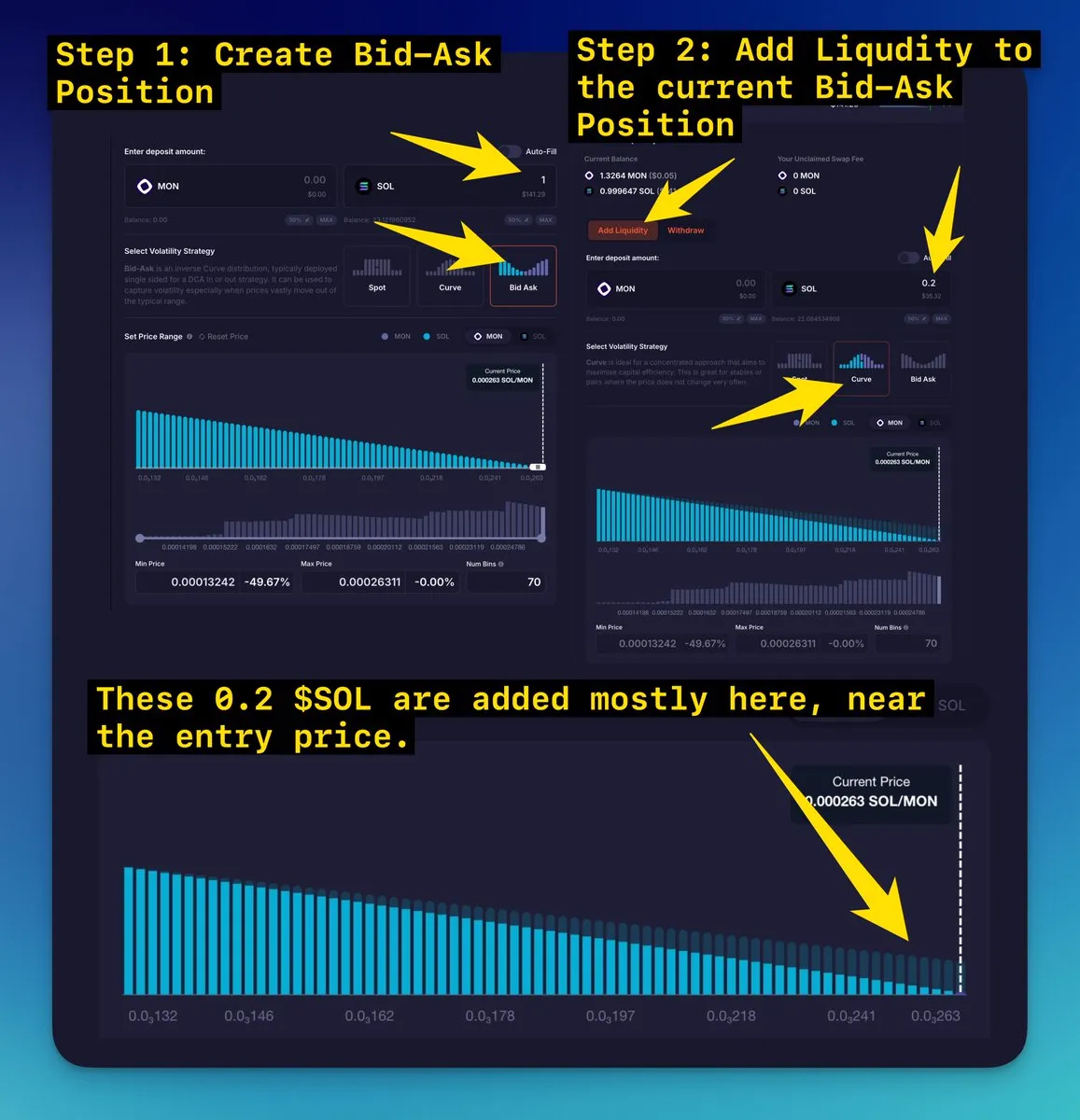
Chart logic: spotting the setup
It's one thing to talk theory, but we only make money by applying this stuff to the charts. Here is exactly how I scout a setup that screams for the Bid-Ask + Curve hybrid on Meteora.
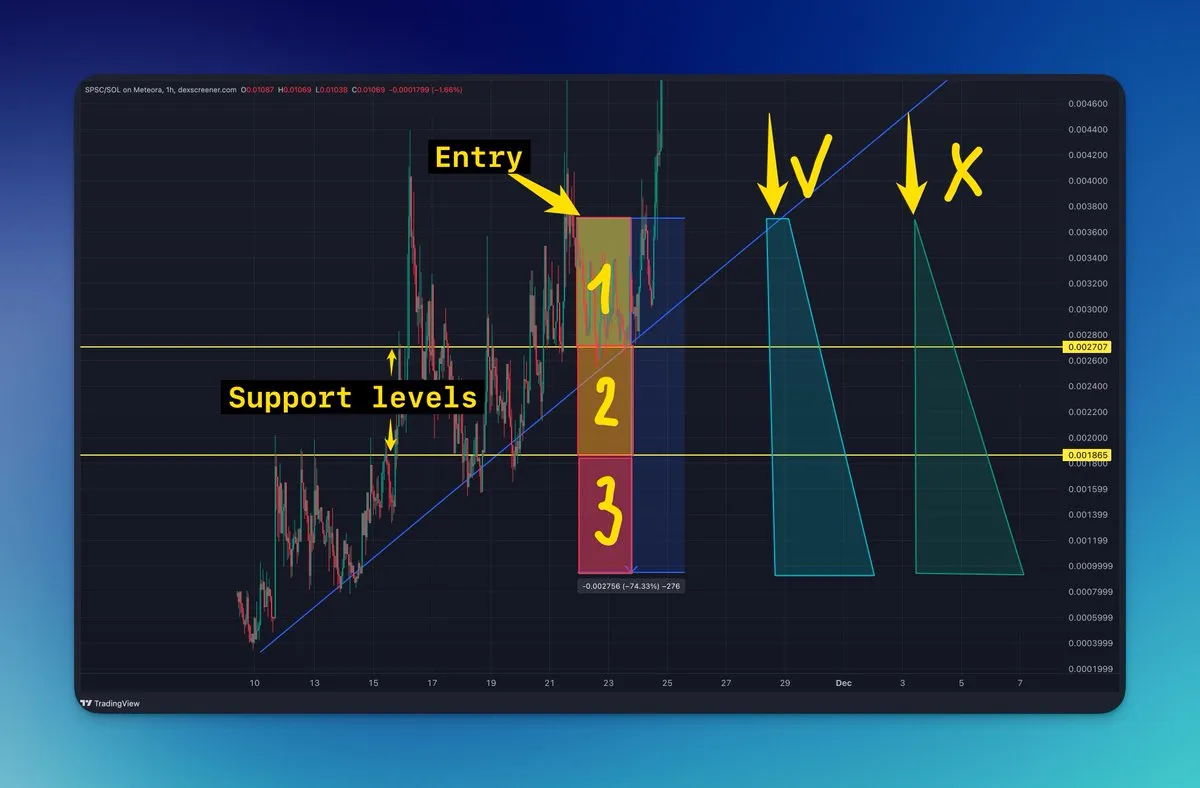
Look at the $SPSC/SOL chart I marked up:
- Clear uptrend: the blue trend line shows a consistent move up. We are moving with the market, not fighting it. This gives us confidence the price will eventually bounce.
- Stacked support: we have multiple, clear support levels below the current price (labeled 1, 2, 3). If the price drops, it has multiple cushions to slow the fall and give us time to react.
- The entry and zone 1/3: my entry is placed high. I'm expecting the price to do what most tokens do after a strong run: consolidate and chop in the upper zone (level 1) for a period.
This consolidation period, where the price sticks in zone 1/3, is the exact scenario where the 80/20 Bid-Ask + Curve setup prints the most fees.
With pure Bid-Ask, your liquidity is focused on zones 2 and 3 (ready for the dips), leaving zone 1 thin on liquidity for fee capture. You are earning less fees during the period when the price is most active.
With the hybrid (Bid-Ask + 20% Curve), the Bid-Ask part (the 80%) is still protecting your downside, stacking liquidity in zones 2 and 3. The Curve part (the 20%) is concentrated in zone 1, right around the current price. This liquidity vacuum maximizes fee collection for all the small, choppy trades happening during the consolidation period.
The market is rewarding patience, and the hybrid is built to collect fees while we wait for a deeper dip. We are optimizing for volatility farming in the current range, not just fighting for the bottom.
Final thoughts
The Curve strategy isn't your full-time ride, it's the surgical tool that prints fees in the choppy middle.
Use two-sided for stablecoin farming, it's pure consistency.
Use the 80/20 hybrid (Bid-Ask + Curve boost) to boost your fees when the price stalls, without sacrificing your downside protection.
Use Curve on Meteora to farm volatility while you wait for the next major move.