The ultimate Meteora guide to start your LP journey.
Everything you need to start LPing on Meteora: DLMM basics, pool research, safe entries, fee claiming, exit strategy, and the tools I use.
Tired of the trenches? Losing SOL on bad trades? Ready for a smarter, more consistent approach?
Put your SOL to work. Become an LP on @MeteoraAG, a next-gen liquidity platform on Solana using DLMM (Dynamic Liquidity Market Making): more control, better fees, smarter liquidity placement.
Let’s dive in.
The Meteora dApp
Your command center for LP: managing liquidity, tracking positions and searching pools.
- Main dApp (stable), for secure, everyday farming: app.meteora.ag
- Edge (experimental), to try new features first: edge.meteora.ag
Master the DLMM basics
Essential before you risk a single SOL.
- Bins = price zones where your liquidity works
- Bin Step = price gap before your liquidity shifts
- Dynamic fees = the higher the volatility, the higher the fees
- Strategies: one-sided or balanced, depending on risk tolerance
Learn these and you’ll understand why DLMM beats classic AMMs.
Where to find the best LP pools
Hunting for fresh, high-fee opportunities? These dashboards and tools make it easier:
- Dashboard by @foxtroteth: DLMM pool tracker on Looker Studio
- Metlex (DLMM 100 tab): metlex.io
- Tokleo
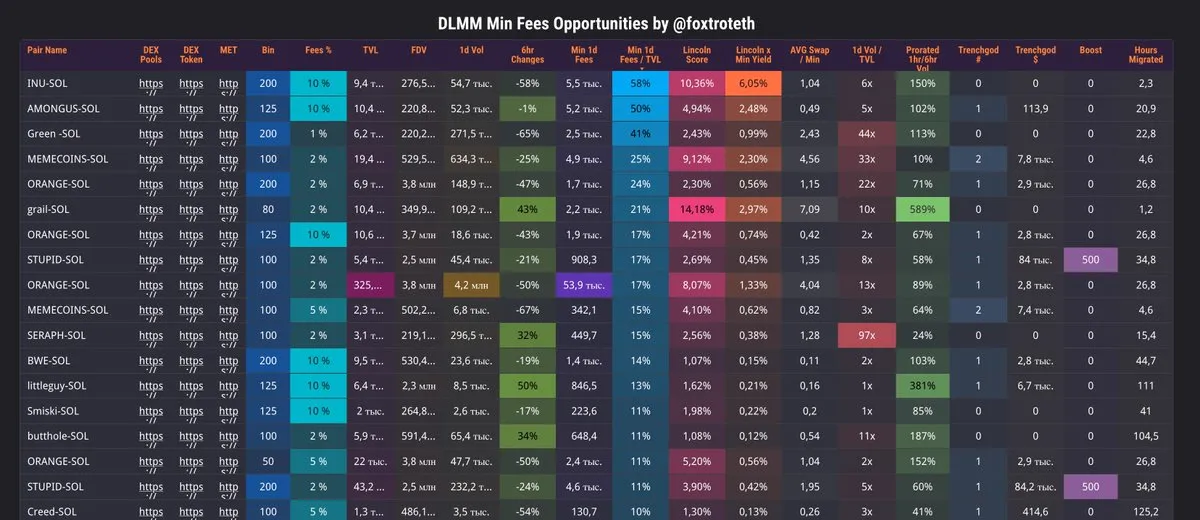
Pool analytics deep dive
Before you jump into any Meteora pool, know exactly what you’re walking into. Here’s what I check every time:
- 24h fees / TVL % = yield potential
- Volume & trade count: more trades, more fees
- Liquidity depth = easier exits
Rug check and security
Before entering a pool, protect your capital:
- Check the contract on Solscan
- Review holder distribution, avoid whales holding >50%
- Look at token age, younger tokens = higher risk
- Socials & community: active and transparent is good
Check the chart before entering a pool
A good chart can mean the difference between farming fees or farming losses:
- Trend direction: uptrend, range, or downtrend?
- Volume: steady activity = steady fees
- Pullbacks: healthy dips are better than vertical pumps
- Whale moves: avoid pools where one wallet controls price
- Pair age: older charts show more reliable patterns
- Always have Plan A & Plan B: know your entry AND your exit before you commit
Full chart analysis in the video:
Open a position on Meteora
Example setup I use for safe entry:
- Bin Step: 100, a wide range that stays active longer
- One-sided SOL: start in the stable asset, buy the token on dips
- Strategy: Bid/Ask, gradually accumulates as price falls, sells on rebounds
Why this works:
- Lower risk than 50/50 (less impermanent loss)
- Flexible exit: close on bounce or hold for trend reversal
Tip: create longer Dynamic Range positions to reduce risk. They stay in range longer, meaning fewer manual adjustments and more consistent fee farming.
Learn how in my video on Dynamic Positions:
 MichaelZogot@MichaelZogot
Full walkthrough of the process:
Tiered entry and risk management
Never put all your SOL in one position. Cap it at max 20% of your total stack.
Tiers based on token market cap and the suggested approach:
- <$1M: high risk / high reward (DEGEN play), go one-sided (SOL or token) for safety
- $1M to $5M: medium risk
Place your pool on the chart
Placing liquidity without seeing the chart is like driving blind.
Bonus: my browser setup for LP on Meteora:
MichaelZogot@MichaelZogotHere’s how I align my pool ranges with price action on DexScreener:
Errors when opening or closing a position
Sometimes the blockchain gets congested. Don’t panic, try this:
- Blockchain busy? Wait a bit and retry
- Switch wallet, it can fix stuck transactions
- Change the RPC endpoint for a faster, more stable connection
- Double-check pool stats before retrying, low activity might not be worth the trouble
My video walkthrough with extra troubleshooting tips:
Position options on Meteora
Once your position is live, you can manage it in several ways:
- Add liquidity: increase size without creating a new position
- Withdraw partially: take some profit or reduce exposure
- Claim fees: collect earned commissions anytime
- Close position: fully exit and retrieve assets
- Adjust strategy: shift bins, change side, or rebalance assets
Full walk-through of all position controls in the video:
Claiming fees
Your fees don’t auto-compound. You need to claim them manually.
How you handle them depends on your strategy:
- Reinvest: add them back into the same position to grow size
- Diversify: use fees to open a new position
- Cash out: move to stablecoins or SOL for realized profit
Example approaches:
- High-volume pool: claim daily, reinvest for compounding
- New or degen pool: claim fast, secure profits before risk catches up
- Stable pool: claim weekly to save on transactions
My full fee-claim process and tips in the video:
Track your LP positions
Tracking your open positions means spotting problems early and making better decisions.
- Monitor fees earned vs. time in position
- Watch price movement vs. your range
- Track PnL per position, not just the overall portfolio
- Stay organized across multiple pools & strategies
My LP tracking workflow and tools:
MichaelZogot@MichaelZogotIn LP farming, tracking isn’t optional. It’s alpha.
A quick overview of my tracking approach:
Create an extra position (Layer Cake strategy)
Adding a second position (or several) can:
- Reduce risk by splitting liquidity into different ranges
- Capture more trading activity across price zones
- Allow different strategies to run in parallel (e.g. one-sided SOL + balanced)
- Give flexibility to close or adjust one position without touching the other
This is part of my Layer Cake Strategy. It comes up again later in this guide.
Full extra-position creation walk-through in the video:
Close the position and swap back to SOL
When it’s time to exit:
- Close the position: withdraw liquidity from the pool
- Claim any pending fees
- Swap tokens back to SOL to consolidate into your base asset
- Review PnL: check if the trade met your target or stop-loss plan
Exit strategy: how to leave the pool like a pro
Know your exit conditions before entering any position.
Based on time
- Volatility too high for your risk tolerance
- Low MCP (market cap potential)
- Liquidity steadily decreasing
Based on the chart
- How much range is left in your position?
- Overnight farming: safe or too risky?
- Strong support levels holding price
Based on fees: define your greedy level, when is “enough” enough?
How to avoid losses
- Control your risk exposure, scale down size if uncertain
- Set mental stop-losses before you enter
- Honest self-evaluation: low-cap memecoins aren’t for everyone
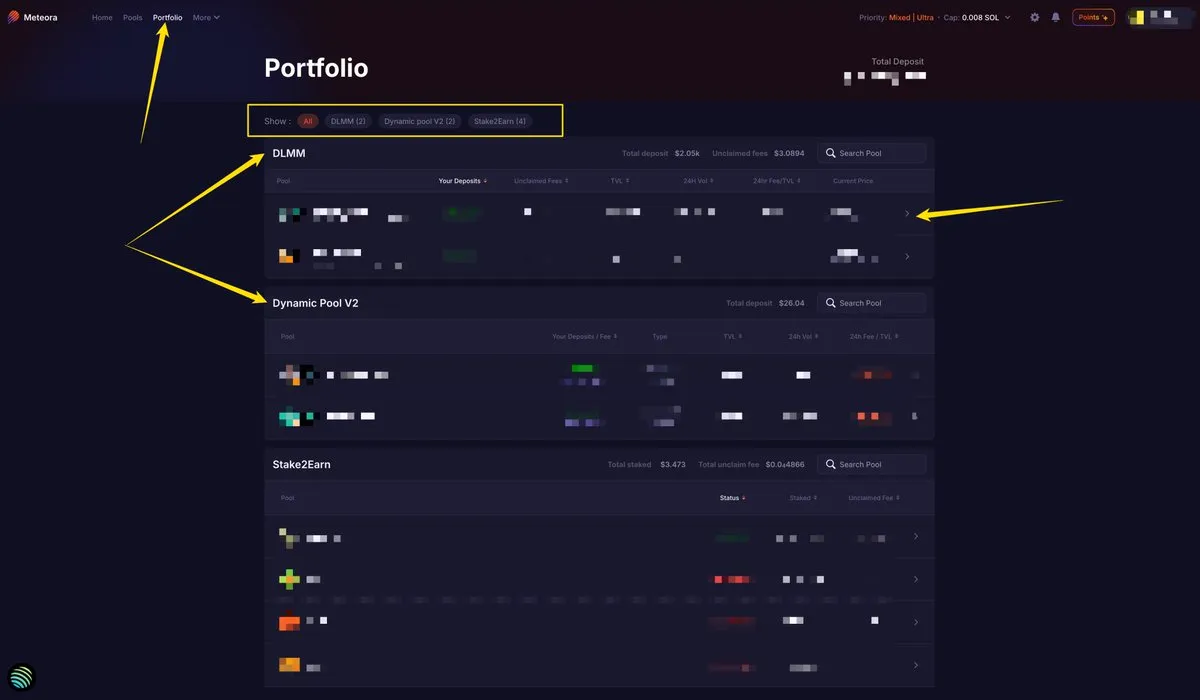
Portfolio overview
The Portfolio tab on Meteora gives you a clear snapshot of all your activity:
- See all active positions in one place
- Track total fees earned
- Monitor asset allocation across pools
- Spot underperforming positions quickly
Check it here: app.meteora.ag/portfolio
Create PnL cards
PnL cards help you track results, spot patterns, and refine your LP strategy:
- Record entry & exit price
- Note the Bin Step and strategy used (one-sided, 50/50, etc.)
- Log fees earned vs. time in position
- Track total PnL (realized + unrealized)
Practice is crucial
Knowledge without action is worthless. To succeed in LPing, you must:
- Build real experience through consistent execution
- Sharpen decision-making skills over time
- Create new positions regularly, with discipline
- Review, learn, and adapt from each trade
Learn from real examples:
- LP position breakdown #1
- LP position breakdown #2
- LP position breakdown #3
- LP position breakdown #4
- LP session on Meteora with an LP Army member
Have a strategy
Without a clear strategy, you’ll get lost in the game.
- Master at least one setup and run it 20+ times
- Adjust and refine as you gain experience
- Consistency builds confidence & better results
My top 4 LP setups cover 90% of my LP activity, built for long-term success and risk protection: repeatable strategies, confidence through consistency, and a focus on minimizing losses.
Watch the full breakdown, including the Layer Cake setup:
Michael Zogotmichaelzogot.xyz · GuidePost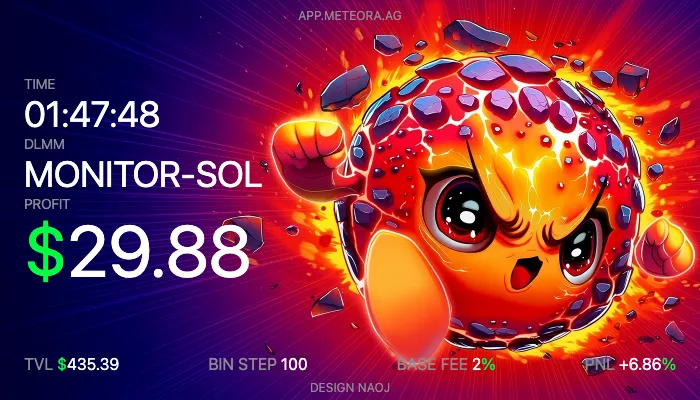
Join the LP Army
This is where Meteora truly shines: a community built for liquidity providers.
- LP Bootcamps: hands-on learning & live examples
- DeFi education: strategies, tools, and market insights
- @met_lparmy: sharing alpha in real time
Questions are welcome. I read them all.