The Bid-Ask bounce play: last chance to win the LP Army challenge.
A token-sided Bid-Ask setup on Meteora that sells into the bounce: how it works, how to cover the risk, and the LP Army challenge rules.
The @met_lparmy Bid-Ask April Challenge ends tomorrow, 19th April 2026 at 9:00 PM UTC. If you haven't submitted yet, this is your final window. $1,000 USDC on the table, split across 5 places, and the highest % PnL wins. Not total fees, not USD value. Just % return on a single Bid-Ask position.
Let's be honest, most of us run Bid-Ask every day. It is the most popular and probably the safest DLMM setup out there. But winning this challenge needs a different angle, and in this article I'll walk you through both. Classic Bid-Ask for your daily flow, and the token-sided bounce play that can realistically print 100%+ on the right chart in a few hours.
NFA and SAFU.
The classic Bid-Ask play (with $SOL as quote token)
I've written about this setup before, so I'll keep it short here.
You open a one-sided $SOL Bid-Ask position. No token exposure on entry. The range sits above or around the current price. When the price moves up through your bins, you sell $SOL for the token on the way. When it dumps back into your range, you are accumulating the token on the way down and collecting fees on every swap in between.
This works because in Bid-Ask, most of your liquidity sits at the edges of the lower range. When price wicks in and out, you capture a disproportionate share of the volume compared to a Spot or Curve setup.
This is the daily setup:
- You only hold $SOL on entry
- You define your max drawdown by where you set the lower bin
- The fees cushion the IL while the token drops
- If the token bounces back up, you exit with more $SOL than you started with
Solid day-to-day play.
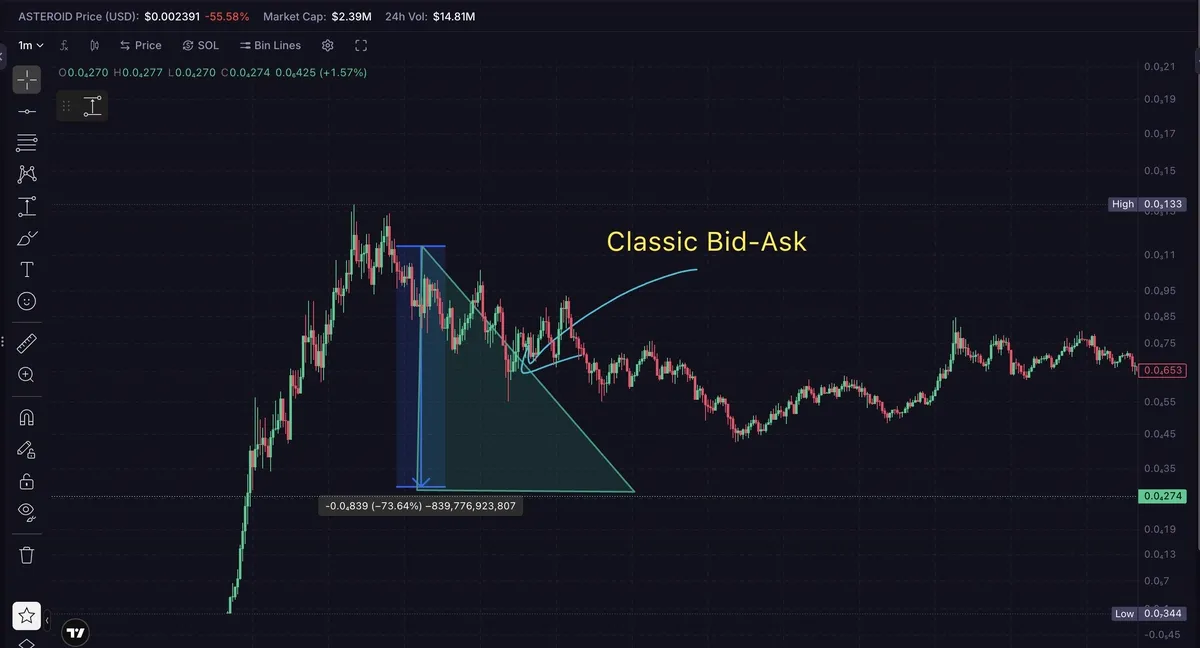
But it's almost never a 200% PnL play in one position. To win the challenge, we need something spicier.
The bounce play: token-sided Bid-Ask on support
Here is the setup for the highest % PnL.
Most tokens, after they have lived a few hours, start to build structure. Clear support levels. Clear resistance. Multiple bounces. Wicks that defend the same zone two or three times. Rejections at the same top. This is where the bounce play lives.
The idea is simple. Instead of farming the move down with $SOL, we buy the token near support with a token-sided Bid-Ask position, and sell it back (by closing the position or Zap-Out) into the market as the price appreciates.
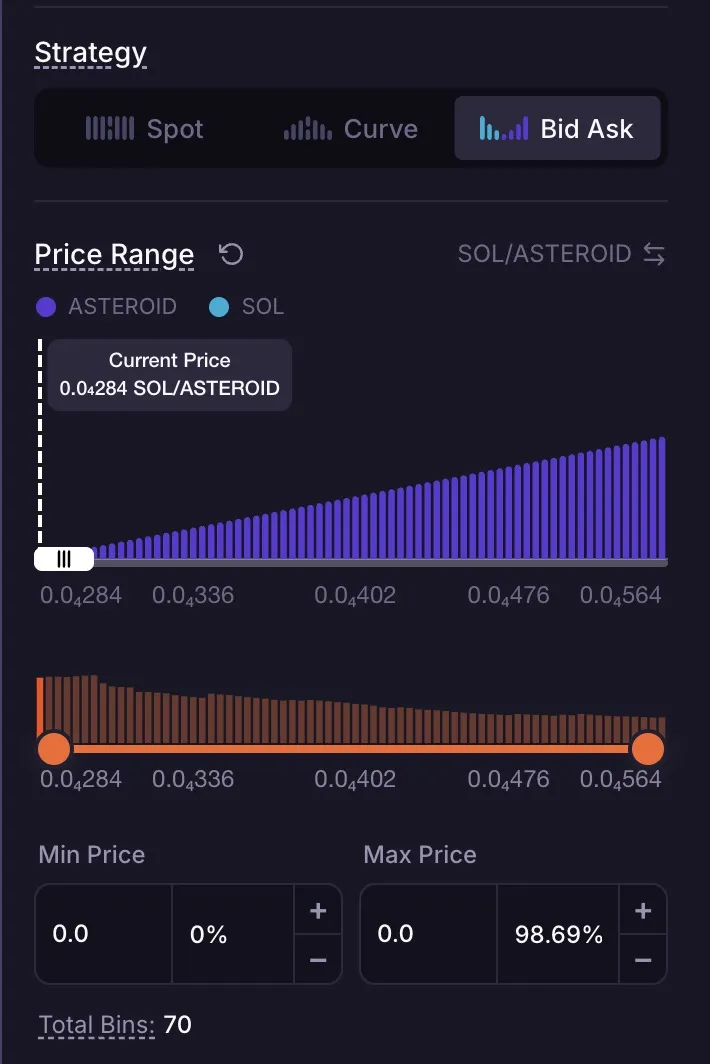
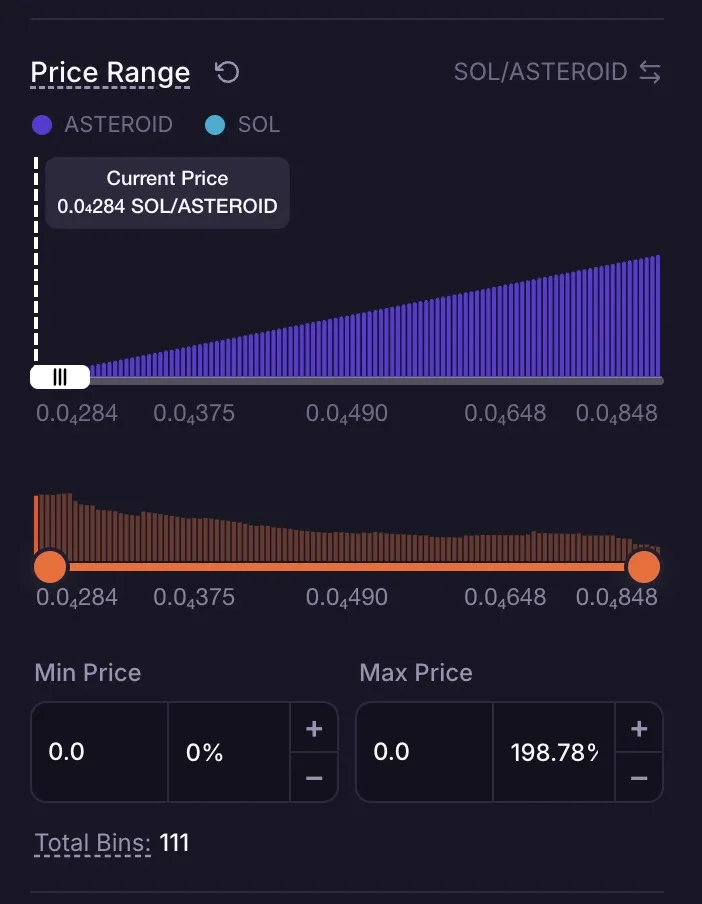
Think of it like a laddered limit order, but better. In a token-sided Bid-Ask, most of your tokens sit at the edge of the upper range. You sell a little near the current price, and more and more as the price climbs higher. You farm the price appreciation AND the fees from every swap along the way.
A 0.5 $SOL position on the right token with a clean 150% move through your range is your winning ticket.
The process, step by step
- Find and observe a token. Use the Discover page for it. Notice: you can even start with a classic one-sided $SOL Bid-Ask to get familiar with the pool, the bin step, how the fees look. Let the chart "live" a bit.
- Look for structure. Support and resistance that have been tested. Good bounces. Clear rejections. If the chart is a random walk with no structure, skip it.
- Wait for the price to fall into a support zone. Don't chase the candle. Enter on the settle. A price drop of 60% is a good indicator for a coming bounce.
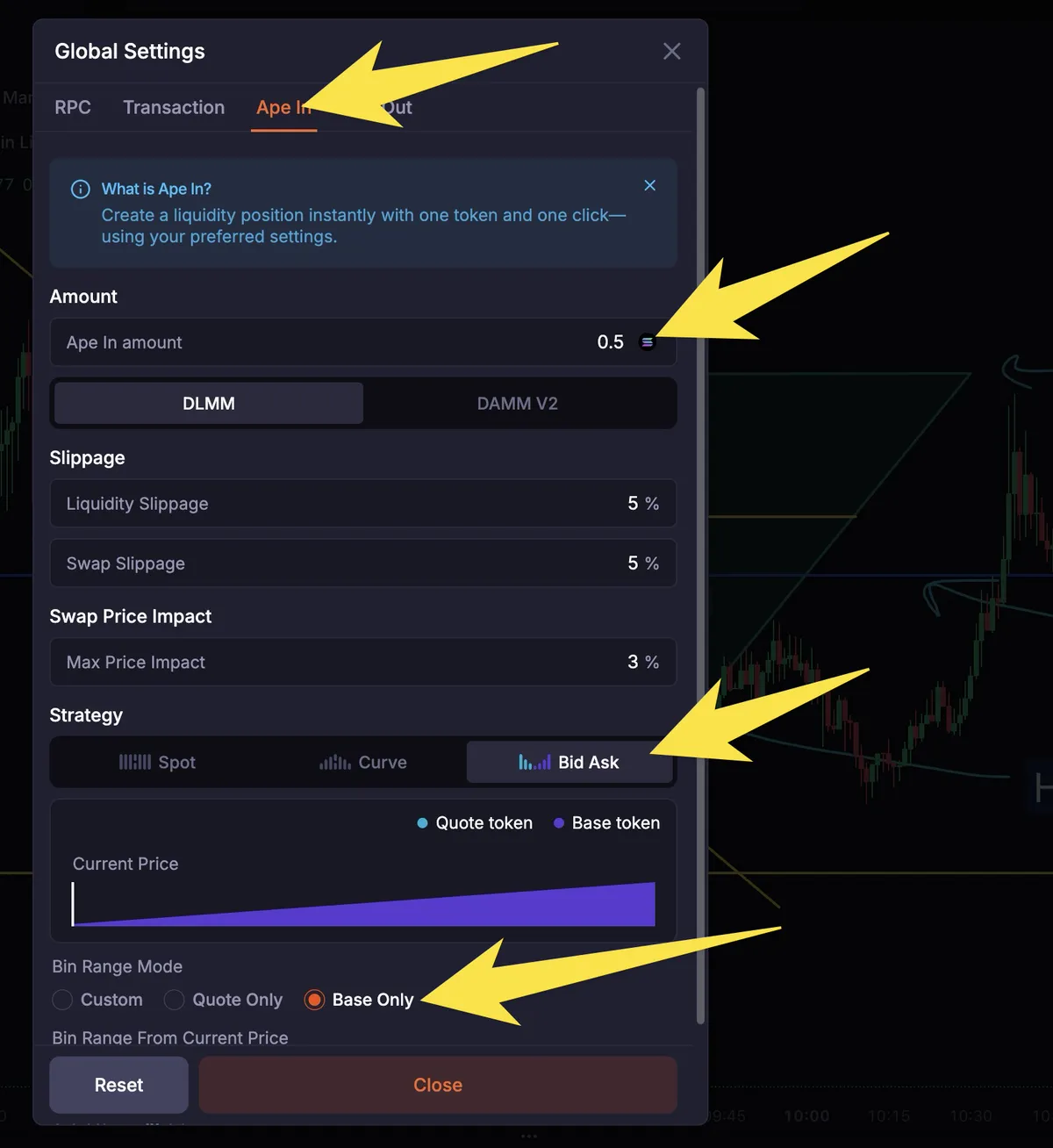
- Get in: use Ape-In to buy the token and create a position in one step. Configure "Ape-In" as "Base Token" and Bid-Ask. One click, position is live on the support level.
- Let the price do its thing. If support holds, the bounce sells into your upper bins. The higher it goes, the more you sell, because that's where most of your tokens sit. Watch your PnL and look at the price on the chart.
- Close the position depending on your profit and where the next resistance sits. Don't be greedy. If you see a good PnL, take it and leave. Using Zap-Out is a good option to quickly close the position and convert it back to $SOL.
$ASTEROID on @MeteoraAG. A clean example of the bounce play risk profile.
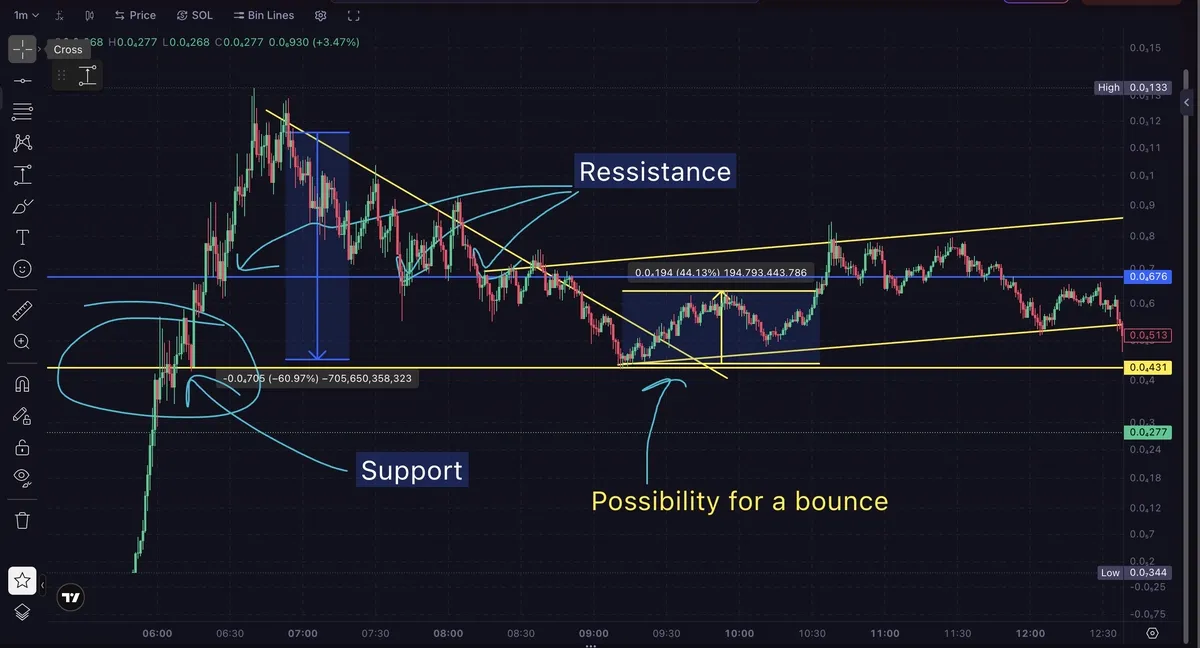
Price just wicked into the lower support zone at around $0.0₃42 (the yellow line at the bottom). Strong bounce off support, and the way back up now has three possible outcomes depending on where it rejects.
- Low chance: price breaks all the way back up above the blue line ($0.0₃67) and rips. Max PnL, clean runner.
- Middle chance: bounce into the middle zone around $0.0₃63, rejection, then sideways. Still positive PnL if you placed the range right.
- High chance: bounce stalls near the first yellow level ($0.0₃59), short squeeze continuation. Realistic PnL, but tighter.
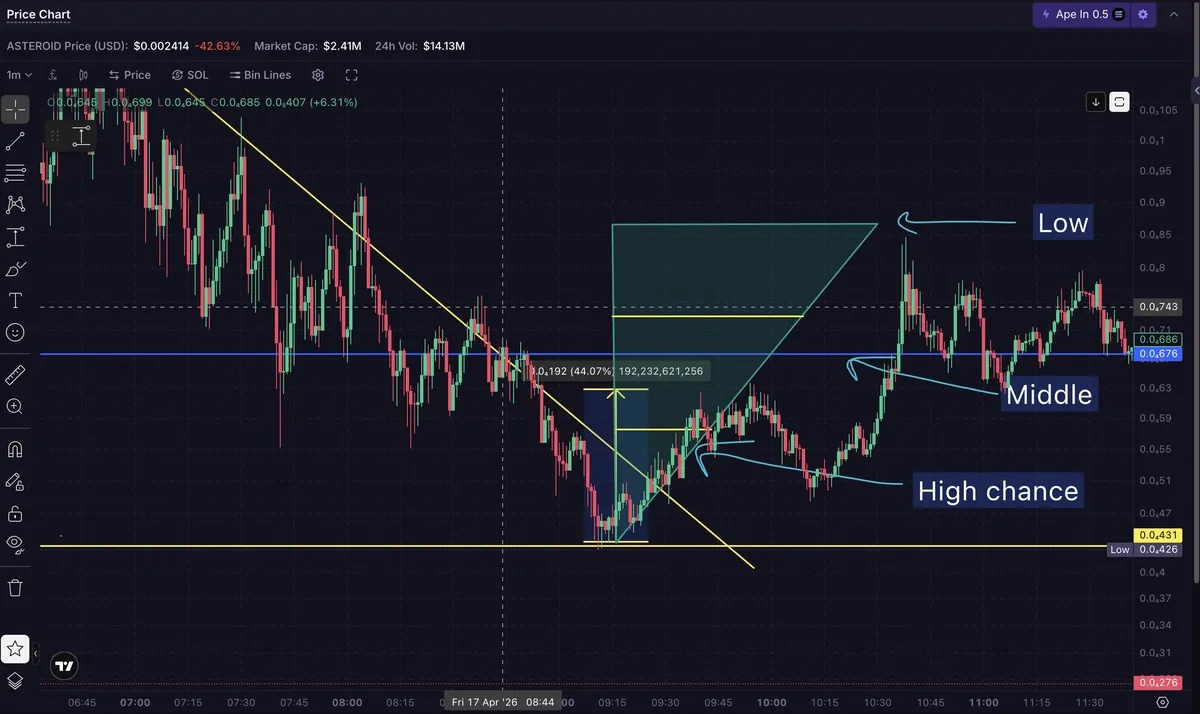
The green triangle shows where my token-sided Bid-Ask bins would sit. Heavy at the lower edge (accumulation on the wick), heavy at the upper edge (selling into the bounce).
The risk is obvious: if support at $0.0₃42 breaks, you are filled with token and no bounce comes. That's why I'd pair this with an additional one-sided $SOL position below, and why I'd split the entry 50/50 instead of dumping everything on one level.
Read the chart before you Ape-In.
The risk (and how to cover it)
The obvious risk: support breaks, the bounce never comes, the token dumps straight through your range. Now you are sitting on a bag of token that is losing value AND you have IL on top.
Two things can help.
First, pair the bounce play with an additional one-sided $SOL Bid-Ask position below your entry. Wider range. This one farms fees from the continued drop AND helps you lower the effective entry if price keeps falling. If the bounce comes, both positions print. If it doesn't, the $SOL leg carries you.
Second, split your entries. Price could bounce from the level a bit below your first entry. Don't dump everything on one support. 50/50 works well. 1 $SOL on the first support, 1 $SOL on the next one down. If the first one wicks and bounces, you are already in profit. If it breaks down, you are averaging into a better price for the bounce that eventually comes.
Heads up for winning this challenge
The rules are clear: highest % PnL wins. For THIS specific challenge, you can only really win if:
- You open Bid-Ask as Base Token (token-sided)
- The token price actually goes up through your range
A $SOL-sided Bid-Ask can print nice PnL over days, or weeks. It will almost never hit 100%+ on a single closed position in hours. For that you need a token pump, and for that you need token-sided.
Size does not matter here. A 0.5 $SOL position printing 200% beats a 50 $SOL position printing 30%. That's the whole game.
Challenge details (last call)
Challenge period: 9th April 2026, 9:00 PM UTC until 19th April 2026, 9:00 PM UTC.
Prize pool:
- 1st place (highest % PnL): 400 USDC
- 2nd place: 250 USDC
- 3rd place: 150 USDC
- 4th place: 120 USDC
- 5th place: 80 USDC
Rules:
- Position must be opened AND closed inside the challenge window
- Minimum position size: 0.5 $SOL
- Strategy must be Bid-Ask
- No rebalances allowed
- No wash trading, no scam pools
- One submission per account. You can re-submit, the latest entry counts
- X post must tag @met_lparmy and include a screen video showing the close of your Bid-Ask position and the PnL card
Submit your entry here: the submission form
You still have time for one or two attempts. Close a good setup, submit it, and if you catch a better bounce tomorrow, open again and re-submit. Only the latest one counts, so there is no reason to sit on the sidelines.
LP Army competition post:
For the long term: the Layer Cake
This challenge is a short-term spike play. But if you want a strategy that works in every market cycle, check out my Layer Cake setup. One-sided $SOL Bid-Ask, layered across support levels, taking profits on bounces, adding size on deeper dips. It is my favorite LP setup and it has carried me through every cycle.
Think of the challenge bounce play as a spicy, one-layer version of the Layer Cake.
Layer Cake post:
 Michael Zogotmichaelzogot.xyz · StrategyPost
One more thing
Clock is ticking. Less than 25 hours left.
Go catch the bounce: app.meteora.ag