My approach to the SOL dip: stacking fees, shorting, and Meteora's new rebalance feature.
How I LP the SOL dip on Meteora: one-sided entries, a short hedge, and the new rebalance feature that resets a 50/50 range in one go.
On @MeteoraAG, I'm currently in full $SOL accumulation mode.
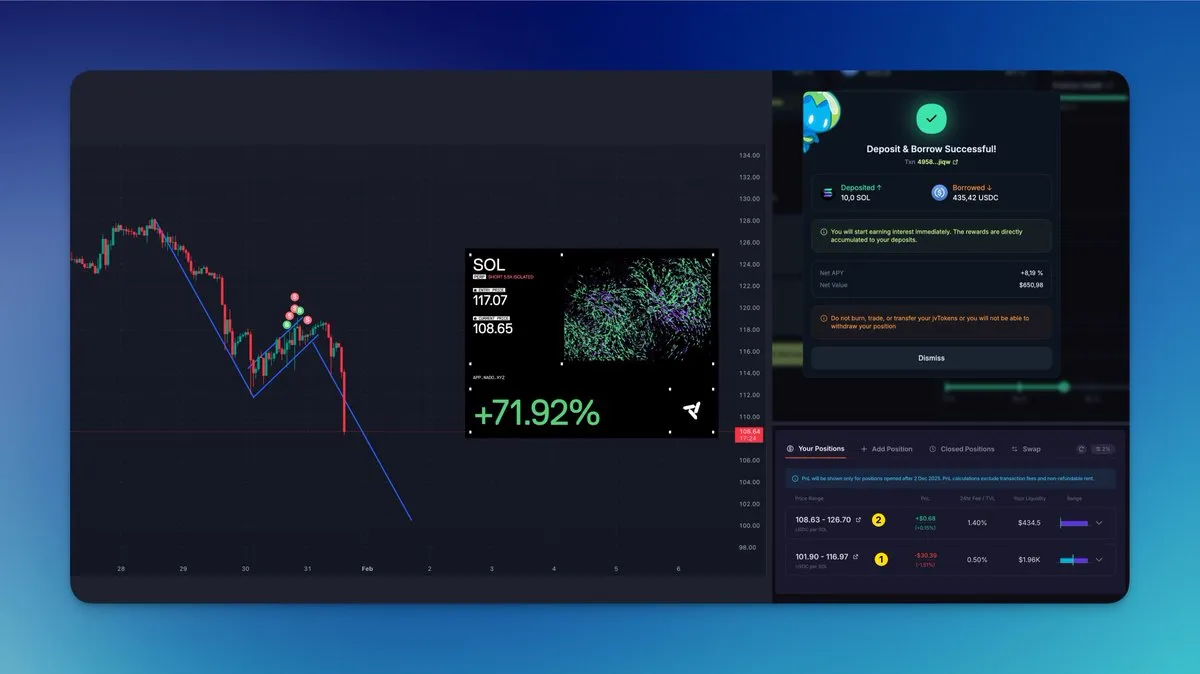
I started it with this tweet.
 MichaelZogot@MichaelZogot
 Jan 31, 2026View on X ↗
My time is being spent stacking $SOL. When the volatility is this high, I fail to see the purpose of just looking at the charts and waiting for a green candle in order to actually construct a position.
I'm currently playing the SOL/USDC pool exactly like this:
The initial game plan
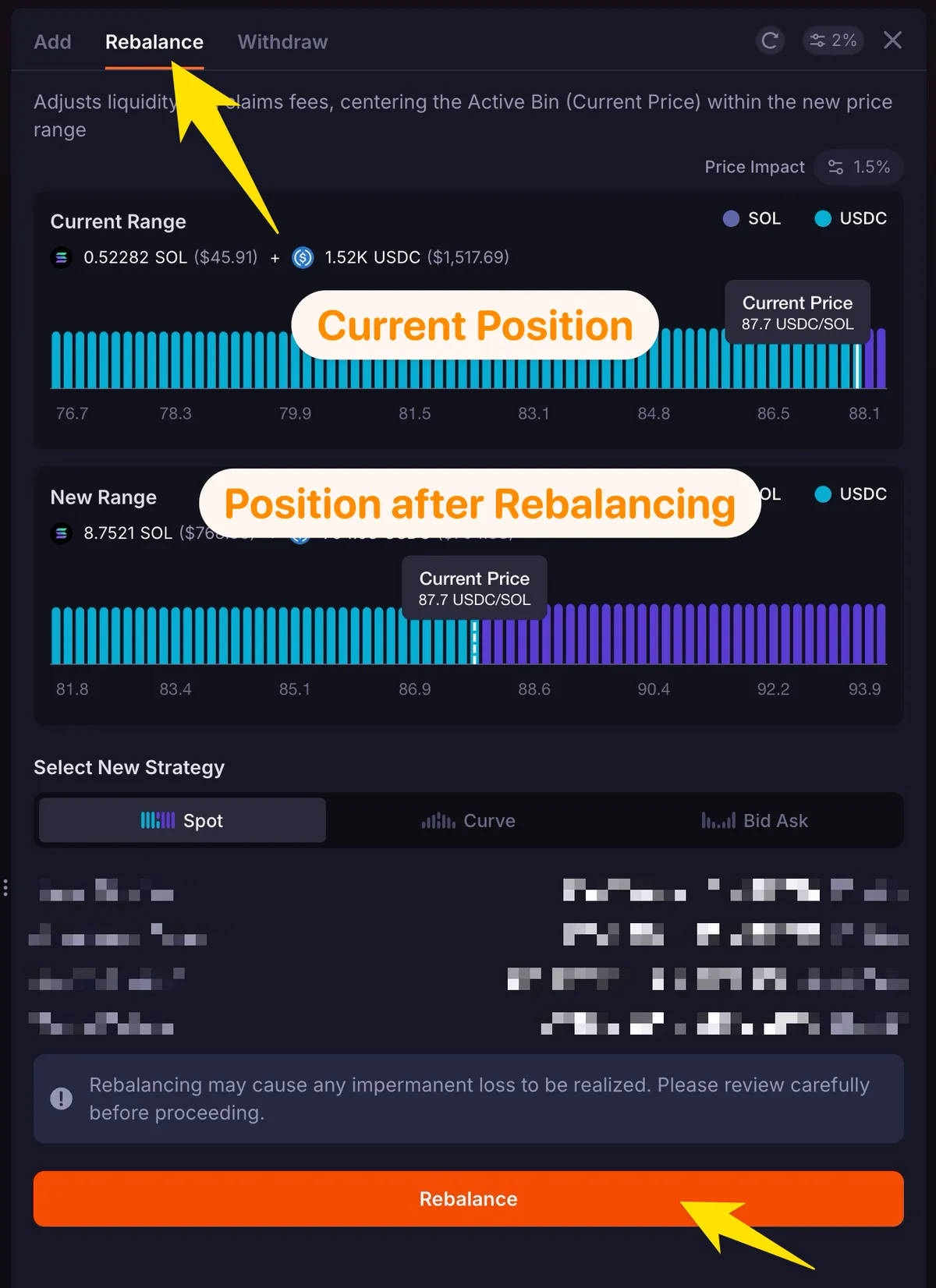
At first, I opened a one-sided position in USDC. This was my net for the dip: I automatically bought $SOL at a lower price and collected fees as the price dropped into my range. I took a direct short on $SOL to protect myself from the move. That short was important because it made up for the first IL (Impermanent Loss) on the first big drop. I already took those profits and bought more $SOL with them.
The pivot: following the price
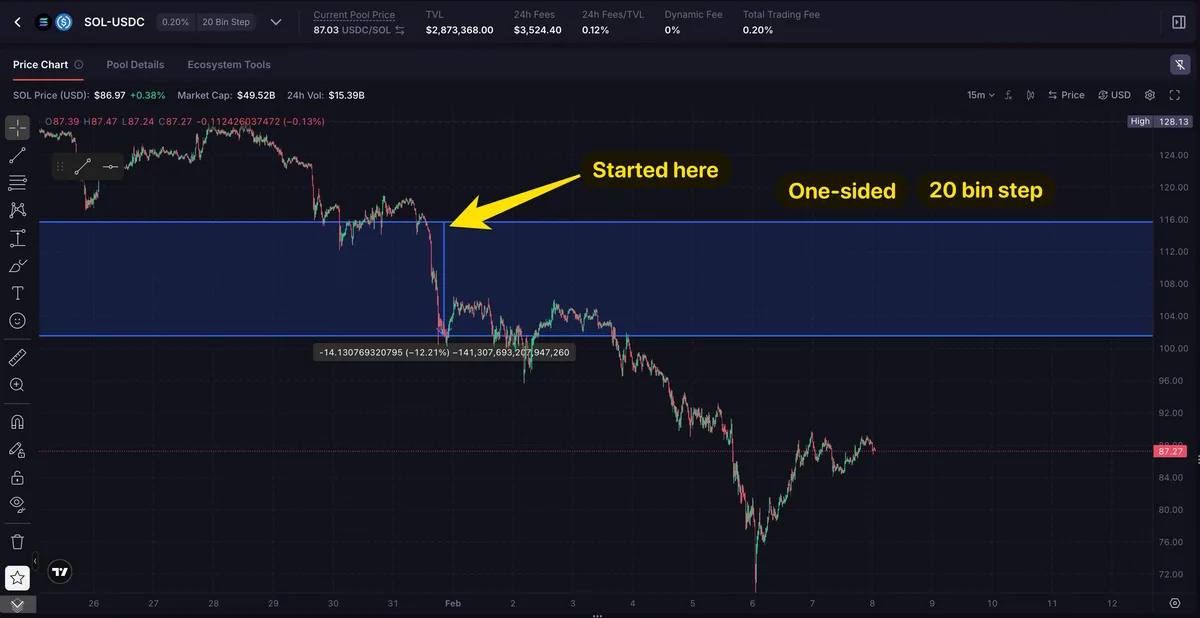
The price went down faster than I thought it would. You would usually be out of range and stuck. The new rebalancing feature on Meteora really shines here. It lets me quickly reset my range to 50/50. It closes and reopens the range on its own, so I don't have to deal with the UI while the market is going down.
The new rebalance feature in Meteora changes the game
When prices change as quickly as they have, your position can "blow out" of range, leaving you with 100% of the lower-value asset and no fee income. In the past, you had to withdraw by hand, switch back to the ratio you wanted, and set up a new position.
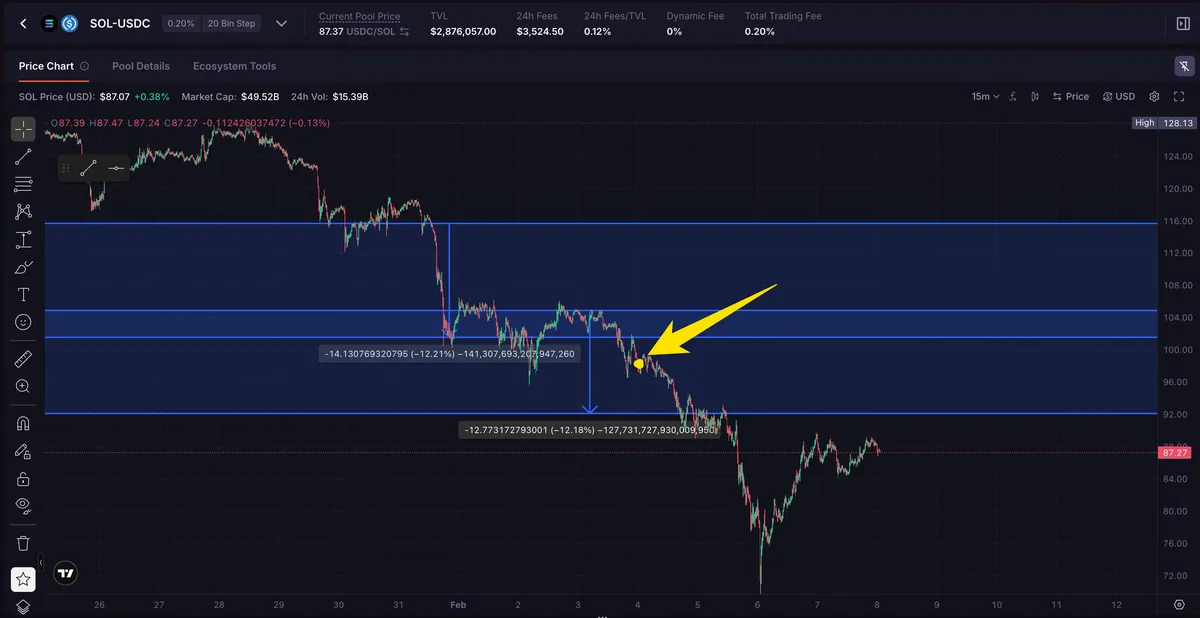
The new Rebalance tool on Meteora takes care of that whole process in one go:
- Instant Range Reset: It automatically takes away your liquidity and centers your bins around the current market price.
- 50/50 Re-centering: This puts your assets back to a balanced 50/50 ratio, so you can get back in the game right away and catch the next move.
- Automated Execution: It does the "closing and reopening" logic for you, so you don't have to worry about making mistakes when you swap or losing money when the market is very volatile.
I use this to "follow the price" down instead of watching the chart all the time. I hit rebalance, reset my 50/50 range, and start farming fees again every time we reach a new support level.
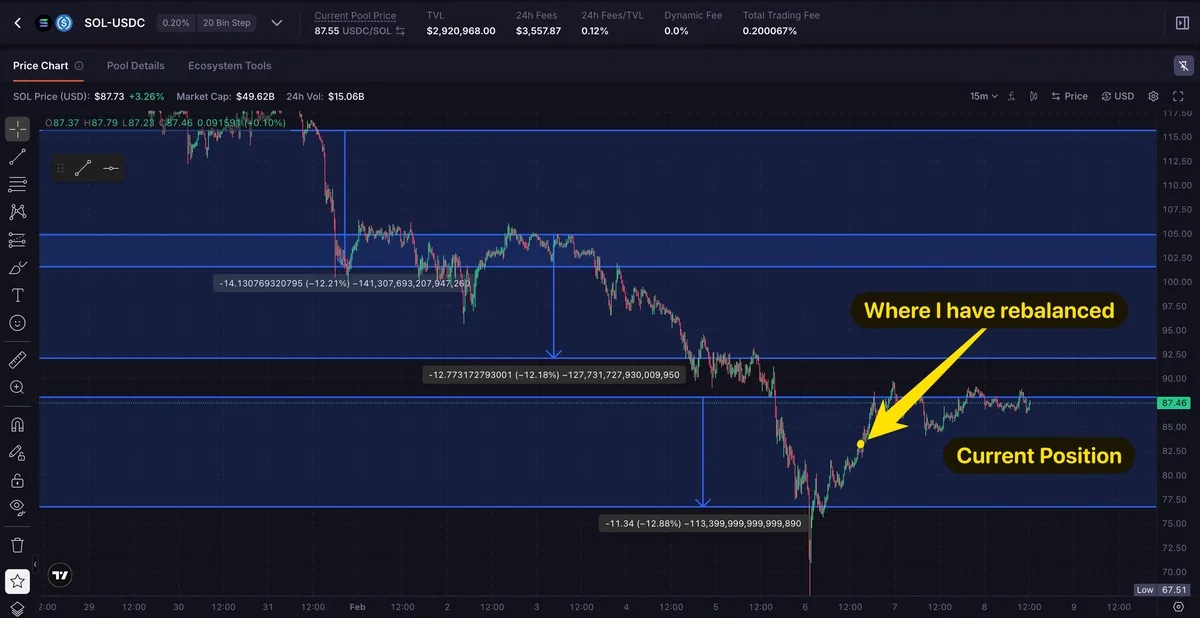
The goal is to farm the sideways move
The plan right now is easy: follow the price. I'm rebalancing as I go to stay active in the bins. A long sideways move is the best thing that could happen right now. I want to sit there, take advantage of the price swings, and turn fees into more $SOL.
I don't compound, I just claim the fees in $SOL and $USDC. When we dip a lot, buy more with the USDC fees.
The "follow the price" playbook: when to rebalance
I'm going to keep the range width at 12% and the step at 20 bins. This is tight enough to cut fees, but you need a clear plan so you don't get lost in the noise.
Here is my simple "decision tree" for rebalancing based on where $SOL goes:
Scenario A: The price goes up and breaks above. It's time to trail SOL up if it closes a 15m candle outside the top of your range and stays there.
- If you think there will be more sideways chop at the new level, you can choose to re-center to neutral (50/50).
- If you think the pump has legs, use a Bullish Skew (putting the spot price in the lower third of your new range). This keeps you in more $SOL so you don't sell out to USDC too quickly.
Scenario B: Price breaks BELOW (the trap of panic). If SOL drops below your range, don't panic-rebalance right away. To rebalance down to 50/50 is to place a "buy" order. You don't want to buy the middle of a waterfall.
- The rule is to wait for a reclaim or a higher low on the 15m chart.
- The Trigger: Only rebalance when the price is stable. This makes sure you're "following" the recovery instead of "feeding" a dump.
Scenario C: The price stays INSIDE (the fee heaven). If the price is going up and down between your alerts, don't do anything.
- The goal is to make money every minute you spend in those bins without rebalancing. This is where the "Layer Cake" gets its taste.
There is no one right time to rebalance. I try to put the center of the position in the middle of a Support and Resistance Level.
This is also why I don't add the $SOL from the fees back to the pool (compound). I don't want to sell it for less money. I'm getting this $SOL ready for the big move up so I can sell it there.
The reality check: the long game and impermanent loss
Let's be honest: there is still some Impermanent Loss (IL) in the position right now (without taking into account the short position and buying SOL for less than $80). The price went down faster than the bins could change, which is why this happened. My short position was the most important thing here because it filled in the gap.
But remember that time is your best friend in these plays, even if you're not shorting. SOL/USDC isn't a flash-in-the-pan memecoin pool; it's a blue-chip powerhouse. I want to farm this volatility for days or even weeks. Volatility doesn't just mean "the price goes down." It also means more trading volume, and more volume means more fees going into your pocket.
If you're just starting out, don't copy my 20-bin setup. Choose a wider range. I'm playing a game that needs to be watched all the time. We will eventually reach a turning point or at least a solid sideways range. That's when I plan to "recover" and make a lot of money as the fees outpace the IL.